


Oracle Database 19c 1Z0-082 Real Exam Questions and Answers FREE Updated on Jun 14, 2026
1Z0-082 Ultimate Study Guide - Dumpexams
The Oracle 1Z0-082 exam consists of 80 multiple-choice questions, and candidates have 120 minutes to complete it. The passing score for 1Z0-082 exam is 63%. Candidates who fail the exam on their first attempt can retake it after 14 days, but they must pay the exam fee again.
NEW QUESTION # 51
Which three statements are true about single-row functions? (Choose three.)
- A. They can be used only in the WHERE clause of a SELECT statement
- B. The argument can be a column name, variable, literal or an expression
- C. They can accept only one argument
- D. The data type returned can be different from the data type of the argument
- E. They can be nested to any level
- F. They return a single result row per table
Answer: B,D,F
NEW QUESTION # 52
Which two tasks can you perform using DBCA for databases? (Choose two.)
- A. Configure a nonstandard block size for a new database
- B. Change the standard block size of an existing database
- C. Register a new database with an available Enterprise Manager Management server
- D. Enable flashback database for an existing database
- E. Configure incremental backups for a new database
Answer: B,C
Explanation:
https://docs.oracle.com/cd/B16254_01/doc/server.102/b14196/install003.htm
NEW QUESTION # 53
Examine this command: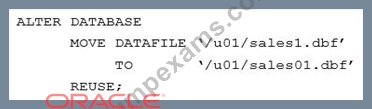
Which two statements are true? (Choose two.)
- A. If Oracle Managed Files (OMF) is used, then the file is renamed but moved to DB_CREATE_FILE_DEST.
- B. DML may be performed on tables with one or more extents in this data file during the execution of this command.
- C. The tablespace containing SALES1.DBF must be altered OFFLINE before executing the command.
- D. The tablespace containing SALES1.DBF must be altered READ ONLY before executing the command.
- E. The file is renamed and stored in the same location
Answer: B,D
NEW QUESTION # 54
Evaluate these commands which execute successfully: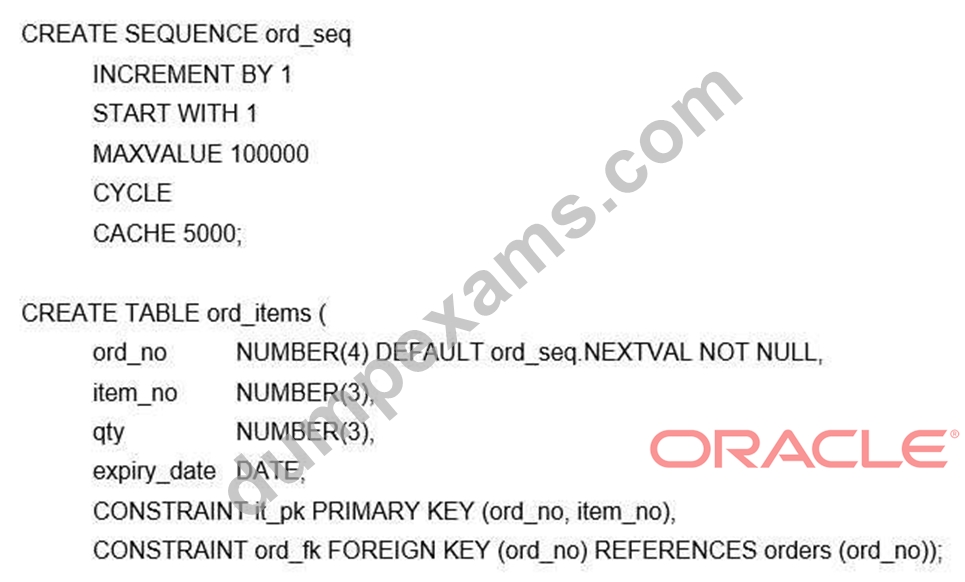
Which two statements are true about the ORD_ITEMS table and the ORD_SEQ sequence? (Choose two.)
- A. Sequence ORD_SEQ is guaranteed not to generate duplicate numbers
- B. Sequence ORD_SEQ cycles back to 1 after every 5000 numbers and can cycle 20 times
- C. If sequence ORD_SEQ is dropped then the default value for column ORD_NO will be NULL for rows inserted into ORD_ITEMS
- D. Any user inserting rows into table ORD_ITEMS must have been granted access to sequence ORD_SEQ
- E. Column ORD_NO gets the next number from sequence ORD_SEQ whenever a row is inserted into ORD_ITEMS and no explicit value is given for ORD_NO
Answer: A,D
NEW QUESTION # 55
The SCOTT/TIGER user exists in two databases, BOSTON_DB and DALLAS_DB, in two different locations.
Each database has a tnsnames.ora file defining DALLAS_DB as a service name.
Examine this command:
CREATE DATABASE LINK dblink1 CONNECT TO scott IDENTIFIED BY tiger USING 'dallas_db'; How do you execute the command so that only SCOTT in BOSTON_DB can access the SCOTT schema in DALLAS_DB?
- A. as SCOTT in both the databases
- B. as SCOTT in DALLAS_DB
- C. as SCOTT in BOSTON_DB and SYS in DALLAS_DB
- D. as SYS in both the databases
- E. as SCOTT in BOSTON_DB
Answer: E
Explanation:
https://docs.oracle.com/cd/B28359_01/server.111/b28310/ds_concepts002.htm#ADMIN12085 Database links are either private or public. If they are private, then only the user who created the link has access; if they are public, then all database users have access.
https://docs.oracle.com/database/121/SQLRF/statements_5006.htm#SQLRF01205
NEW QUESTION # 56
Which three statements are true about Oracle synonyms? (Choose three.)
- A. A synonym cannot be created for a PL/SQL package
- B. A synonym can be available to all users
- C. Any user can drop a PUBLIC synonym
- D. A SEQUENCE can have a synonym
- E. A synonym created by one user can refer to an object belonging to another user
Answer: B,D,E
Explanation:
https://docs.oracle.com/cd/B19306_01/server.102/b14200/statements_7001.htm
NEW QUESTION # 57
An Oracle database session has an uncommitted transaction in progress which updated 5000 rows in a table.
Which three situations does the transaction complete thereby committing the updates?
- A. when a DBA issues a successful SHUTDOWN IMMEDIATE statement and the user then issues a COMMIT
- B. when a DBA issues a successful SHUTDOWN TRANSACTIONAL statement and the user then issues a COMMIT
- C. when a CREATE TABLE AS SELECT statement is executed unsuccessfully in the same session
- D. when a CREATE INDEX statement is executed successfully in the same session
- E. when a COMMIT statement is issued by the same user from another session in the same database instance
- F. when the session logs out successfully
Answer: B,D,F
NEW QUESTION # 58
Which two statements are true about trace files produced by the Oracle Database server?
(Choose two.)
- A. They can be written by background processes
- B. Trace files are written to the Fast Recovery Area (FRA)
- C. Trace file names are based on the database name concatenated with a sequential number
- D. All trace files contain error information that require contacting Oracle Support
- E. They can be written by server processes
Answer: A,E
Explanation:
https://gerardnico.com/db/oracle/trace_file
NEW QUESTION # 59
Which three statements are true about using SQL*Plus?
- A. It has its own commands that are separate from any SQL statements.
- B. It can run scripts passed to it by a shell script.
- C. It can run Recovery Manager (RMAN) commands.
- D. It must be downloaded from the Oracle Technology Network (OTN).
- E. It can run scripts entered at the SQL prompt.
- F. It has both command-line and graphical user interfaces (GUI).
Answer: A,D,E
NEW QUESTION # 60
The ORCL database has RESUMABLE__TIMEOUT = 7200 and DEFERRED_SEGMENT_CREATION = FALSE User U1 has a 1 MB quota in tablespace DATA.
U1 executes this command:
SQL> CREATE TABLE t1 AS
(SELECT object_name, sharing, created
FROM dba_objects);
U1 complains that the command is taking too long to execute.
In the alert log, the database administrator (DBA) finds this:
2017-03-06T12:15:17.183438+05:30
statement in resumable session 'User U1(136), Session 1, Instance 1' was suspended due to ORA-01536: space quota exceeded for tablespace 'DATA' Which are three actions any one of which the DBA could take to resume the session? (Choose three.)
- A. Set AUTOEXTEND ON for data files in DATA
- B. Drop other U1 objects in DATA
- C. Increase U1's quota sufficiently in DATA
- D. Add a data file to DATA
- E. Set DEFERRED_SEGMENT_CREATION to TRUE
- F. Grant UNLIMITED TABLESPACE to U1
Answer: B,C,F
NEW QUESTION # 61
Which two statements are true about views used for viewing tablespace and datafile information? (Choose two.)
- A. Tablespace free space can be viewed in V$TABLESPACE
- B. Tablespace free space can be viewed in DBA_TABLESPACES
- C. V$TABLESPACE displays information about tablespaces contained in the data dictionary
- D. V$TABLESPACE displays information that is contained in the controlfile about tablespaces
- E. A datafile can be renamed when the database is in MOUNT state and the new file name is displayed when querying DBA_DATA_FILES after the database is opened
Answer: D,E
NEW QUESTION # 62
You execute this command: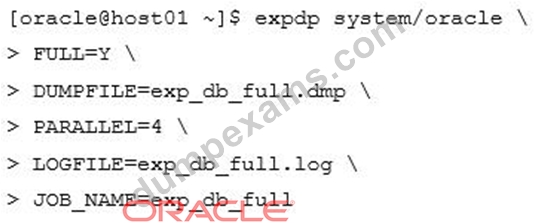
During the export operation, you detach from the job by using CTRL+C and then execute this command:
Export> STOP_JOB=immediate
Are you sure you wish to stop the job ([yes]/no): yes
Which two statements are true about the job? (Choose two.)
- A. It is paused and can be resumed
- B. You can reattach to it and monitor it
- C. It terminates
- D. It continues to run in the background
- E. You can no longer monitor it
Answer: C,E
Explanation:
https://blog.oracle48.nl/killing-and-resuming-datapump-expdp-and-impdp-jobs/
NEW QUESTION # 63
You execute this command:
CREATE SMALLFILE TABLESPACE sales
DATAFILE '/u01/app/oracle/sales01.dbf
SIZE 5G
SEGMENT SPACE MANAGEMENT AUTO;
Which two actions must you take to ensure UNDOTBS01 is used as the default UNDO tablespace? (Choose two.)
- A. Free space is managed using freelists
- B. Any data files added to the tablespace must have a size of 5 gigabytes
- C. It is a locally managed tablespace
- D. It must be smaller than the smallest BIGFILE tablespace
- E. It uses the database default blocksize
Answer: C,E
NEW QUESTION # 64
Which two statements are true about the results of using the INTERSECT operator in compound queries? (Choose two.)
- A. Column names in each SELECT in the compound query can be different
- B. INTERSECT returns rows common to both sides of the compound query
- C. The number of columns in each SELECT in the compound query can be different
- D. INTERSECT ignores NULLs
- E. Reversing the order of the intersected tables can sometimes affect the output
Answer: A,B
Explanation:
https://www.oracletutorial.com/oracle-basics/oracle-intersect/
NEW QUESTION # 65
The SALES_Q1 and USERS tablespaces exist in one of your databases and TEMP is a temporary tablespace.
Segment creation is not deferred.
You execute this command: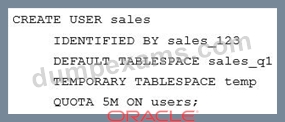
Which three statements must be true so that the SALES user can create tables in SALES_Q1? (Choose three.)
- A. The sales user must have a quota on the SALES_Q1 tablespace to hold all the rows to be inserted into any table in their schema
- B. The sales user must have a quota on the TEMP tablespace
- C. The sales user must have been granted the CREATE SESSION privilege
- D. The sales user must have their quota on the users tablespace removed
- E. The sales user must have a quota on the SALES_Q1 tablespace to hold the initial extends of all tables they plan to create in their schema
- F. The sales user must have been granted the CREATE TABLE privilege
Answer: D,E,F
NEW QUESTION # 66
You want to apply the principle of Least Privilege in all your live databases.
One of your requirements is to revoke unnecessary privileges from all users who have them using Privilege Analysis.
Which three types of analyses can be done using the DBMS_PRIVILEGE_CAPTURE package? (Choose three.)
- A. analysis of privileges that a user has on their own schema objects that they did use
- B. analysis of all privileges used by all users but excluding administrative users in the database
- C. analysis of all privileges used by all users including administrative users in the database
- D. analysis of privileges that a user has on their own schema objects that they did not use
- E. analysis of privileges granted indirectly to a role that are then used by a user who has been granted that role
- F. analysis of privileges granted directly to a role that are then used by a user who has been granted that role
Answer: B,E,F
Explanation:
https://docs.oracle.com/en/database/oracle/oracle-database/19/dbseg/performing-privilege-analysis-find-privilege-use.html#GUID-AD683DDB-D345-4702-B1F4-37B79F276B66
NEW QUESTION # 67
Which two statements are true about single row functions? (Choose two.)
- A. CEIL : can be used for positive and negative numbers
- B. MOD : returns the quotient of a division operation
- C. TRUNC : can be used to combine any number of values
- D. FLOOR : returns the smallest integer greater than or equal to a specified number
- E. CONCAT : can be used to combine any number of values
Answer: B,C
Explanation:
Explanation/Reference: https://docs.oracle.com/en/database/oracle/oracle-database/18/sqlrf/Single-Row- Functions.html#GUID-B93F789D-B486-49FF-B0CD-0C6181C5D85C
NEW QUESTION # 68
Examine this description of the books table containing 100 rows: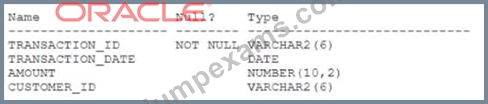
Now examine this sequence of statements Issued In a new session;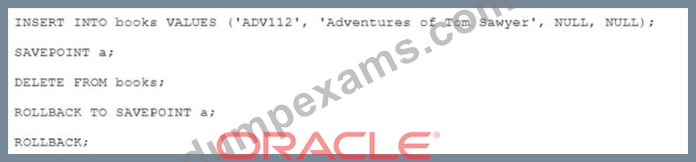
Examine this description of the books table containing 100 rows:
Which three statements are true?
- A. The first RollBack command restores the row that was inserted.
- B. The first rollback command restores the 100 rows that were in the table originally.
- C. The second rollback command restores the 100 rows that were in the table originally.
- D. The first rollback command leaves the table's 100 original rows locked.
- E. The second rollback command rolls back the rollback to savepoint a command.
- F. The first rollback command leaves the inserted row locked.
- G. The second rollback command restores the row that was inserted.
Answer: A,E,G
NEW QUESTION # 69
Which three Oracle database space management features will work with both Dictionary and Locally managed tablespaces? (Choose three.)
- A. Capacity planning growth reports based on historical data in the Automatic Workload Repository (AWR)
- B. Online table segment shrink
- C. Online index segment shrink
- D. Automatic data file extension (AUTOEXTEND)
- E. Oracle Managed Files (OMF)
Answer: A,D,E
NEW QUESTION # 70
You currently have an active transaction in your session and have been granted select access to vstransaction.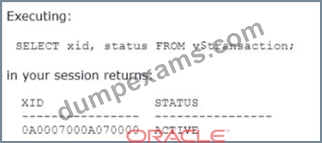
In which three situations will re-executing this query still return a row but with a different XID, indicating a new transaction has started?
- A. after successfully executing a commit or rollback followed by a DML statement
- B. after successfully executing a create table statement followed by a create index statement
- C. after successfully executing a commit or rollback followed by a select statement
- D. after successfully executing a truncate statement followed by a DML statement
- E. after successfully executing a create table as select statement followed by a select for update statement
- F. after successfully executing a DML statement following a failed DML statement
Answer: A,D,E
NEW QUESTION # 71
Examine this description of the TRANSACTIONS table: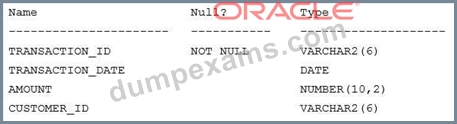
Which two SQL statements execute successfully? (Choose two.)
SELECT customer_id AS "CUSTOMER-ID", transaction_date AS DATE, amount + 100
- A. "DUES" FROM transactions;
SELECT customer_id AS "CUSTOMER-ID", transaction_date AS "DATE", amount + 100 - B. transactions;
SELECT customer_id AS 'CUSTOMER-ID', transaction_date AS DATE, amount + 100 - C. DUES FROM transactions;
SELECT customer_id AS CUSTOMER-ID, transaction_date AS TRANS_DATE, amount + - D. 100 "DUES AMOUNT" FROM transactions;
SELECT customer_id CUSTID, transaction_date TRANS_DATE, amount + 100 DUES FROM - E. 'DUES AMOUNT' FROM transactions;
Answer: B,C
NEW QUESTION # 72
In your data center, Oracle Managed Files (OMF) is used for all databases.
All tablespaces are smallfile tablespaces.
SALES_Q1 is a permanent user-defined tablespace in the SALES database.
Examine this command which is about to be issued by a DBA logged in to the SALES database:
ALTER TABLESPACE sales_q1 ADD DATAFILE;
Which are two actions, either one of which you could take to ensure that the command executes successfully? (Choose two.)
- A. Specify a path in the DATAFILE clause of the command specifying a location with at least 100M of available space.
- B. Ensure that DB_RECOVERY_FILE_DEST and DB_CREATE_FILE_DEST each specify with at least 50 Mb of available space.
- C. Add the AUTOEXTEND ON clause with NEXT set to 100M.
- D. Ensure that DB_RECOVERY_FILE_DEST and DB_CREATE_FILE_DEST each specify locations with at least 50 Mb of available space.
- E. Ensure that DB_CREATE_FILE_DEST specifies a location with at least 100 Mb of available space.
Answer: A,E
NEW QUESTION # 73
......
Oracle 1Z1-082 (Oracle Database Administration I) Certification Exam is designed to test the skills and knowledge of individuals who are seeking to become database administrators. 1Z0-082 exam is ideal for individuals who are interested in managing and maintaining an Oracle database environment. 1Z0-082 exam is designed to test the candidate's understanding of various topics such as database architecture, backup and recovery, security, performance tuning, and Oracle database management tools.
Ultimate Guide to Prepare 1Z0-082 Certification Exam for Oracle Database 19c: https://pdftorrent.dumpexams.com/1Z0-082-vce-torrent.html