


New LookML-Developer Test Materials & Valid LookML-Developer Test Engine
LookML-Developer Updated Exam Dumps [2022] Practice Valid Exam Dumps Question
Google LookML-Developer Exam Syllabus Topics:
| Topic | Details |
|---|---|
| Topic 1 |
|
| Topic 2 |
|
| Topic 3 |
|
| Topic 4 |
|
| Topic 5 |
|
| Topic 6 |
|
| Topic 7 |
|
| Topic 8 |
|
NEW QUESTION 25
A developer is defining the users table within a view file in Looker. The users table will be available as an individual Explore and it will also be joined into other Explores, such as the products Explore. The developer needs to limit the fields visible in the products Explore without affecting the visibility of the fields in the users Explore.
How should the developer meet this requirement?
- A. Create duplicate dimensions and measures, one for the users Explore and one for the products Explore, and use the hidden parameter to modify the visibility of the fields.
- B. Use the fields parameter at the join level for the products Explore to specify which fields should be included and leave the users Explore as is.
- C. Use the hidden parameter in the users view file for the fields that should not come over to the products Explore and leave the users Explore as is.
- D. Create two view files for the users table. One view file will have all possible fields for the users Explore, and the other will have only the fields required for the products Explore.
Answer: B
NEW QUESTION 26
A LookML developer is creating a new view with 20 dimensions in Development Mode using the Create View from Table functionality. Now users want the developer to add only four dimensions from this new view to an existing Explore.
What can the developer add to the Explore to limit the number of fields from the view that are accessible to the user in the Explore?
- A. Join condition
- B. Hidden parameter
- C. Set definition
- D. Fields parameter
Answer: A
NEW QUESTION 27
Two developers are working on adding a new view to a project. Once both developers have finished their work in the view, the changes will be pushed to production.
Where should the developers write the LookML for this view?
- A. In the master branch, with both users writing to the branch
- B. In one user's personal branch, with both users writing to the branch
- C. In each of their personal branches, with each user writing code separately
- D. In a new shared branch created from the master branch
Answer: D
NEW QUESTION 28
Users have built a popular dashboard and want to have change management built in for any edits made to the dashboard. The developer sets up version control for the model on which the dashboard is based.
What should the developer build to meet the business requirement?
- A. A dashboard LookML file included in the project.
- B. A native derived table based on the dashboard.
- C. An Explore LookML file based on the dashboard.
- D. A link to the dashboard included in the project.
Answer: A
NEW QUESTION 29
After running the LookML Validator, a developer sees the following error message in the Looker development environment:
"Measures with Looker aggregations (sum, average, min, max, list types) may not reference other measures".
What could be causing this error?
- A. A measure of type: sum has a SUM function written in the sql parameter.
- B. A measure of type: number has a SUM function written in the sql parameter.
- C. A measure of type: count has a sql parameter defined.
- D. A measure of type: sum adds up other measures in the sql parameter.
Answer: C
NEW QUESTION 30
A developer needs to implement three persistent derived tables (PDTs) as described below.
The PDTs need to be refreshed after the daily ETL pipeline adds incremental loads to the underlying tables.
Each PDT is built off of one underlying table in the database (one PDT per table).
The underlying tables for each PDT are updated one after the other, and a new row is added to an ETL log table each time a table is updated.
Due to the unpredictable nature of the ETL pipeline, each PDT does not refresh at the same time from day to day.
Each PDT takes over an hour to build, and to save on compute costs each PDT should only be refreshed once per day.
How can the developer set up the PDTs according to these requirements?
- A. Create three separate datagroups tied to three PDTs that run when a new row is added to the ETL log table.
- B. Create one datagroup tied to all three PDTs that runs when the total row count across all three tables changes.
- C. Create one datagroup tied to all three PDTs that parameterizes the view name for each PDT in the SQL trigger condition.
- D. Create three separate datagroups tied to three PDTs that run when each corresponding table's row count changes.
Answer: A
NEW QUESTION 31
Users must be able to click on the Country field in their Explore and be redirected to another Explore that shows all countries compared.
Which parameter should be added to the country dimension to create a connection to this other associated Explore?
- A. drill_fields
- B. url_encode
- C. link
- D. tags
Answer: C
NEW QUESTION 32
A user reports the following SQL error when selecting the discounted sale price field:
ERROR: column "order_items.sale_price"; must appear in the GROUP BY clause or be used in an aggregate function.
The developer checks the field definition and finds it to be:
measure: discounted_sale_price {
type: number
sql: ${sale_price} * 0.8 ;;
}
The developer also finds the LookML definition of the sale_price field to be:
dimension: sale_price {
type: number
sql: ${TABLE}.sale_price ;;
}
What is the likely cause of the SQL error?
- A. The sale_price field should be defined as a measure of type: number, not as a dimension.
- B. The underlying database table does not have a field called sale_price.
- C. The discounted_sale_price field should have a group_by: yes parameter.
- D. The discounted_sale_price field should be defined as a dimension of type: number, not as a measure.
Answer: A
NEW QUESTION 33
A user is seeing an error in the Explore that indicates the primary key defined for a one-million-row table is not unique.
How can the developer use SQL Runner to troubleshoot quickly?
- A. Create a query that selects the primary key from the base view, and look for duplicates.
- B. Create a query that concatenates two columns to create a compound primary key.
- C. Create a query that selects all the fields from the table, and sort by primary key.
- D. Create a query that counts how many occurrences of the primary key value are in the base view, and sort by count.
Answer: B
NEW QUESTION 34
The developer is creating an Explore that includes the product users, and orders views that will meet the following guidelines.
Joins between the orders and users views should not incur high performance costs.
Users of this Explore will primarily be looking at data from the orders view.
Users of this Explore should only be able to see orders from the retailer "Fashion.ly".
The only field the users need from the products view is product.name.
Which LookML should the developer use?
A)
B)
C)
D)
- A. Option C
- B. Option B
- C. Option A
- D. Option D
Answer: D
NEW QUESTION 35
A developer creates a derived table and wants to add persistence to it. Because the table is not used on a frequent basis, the developer wants the table to be cached for 12 hours, but only when a user has queried it.
Which persistence parameter should be added to the derived table's definition in order to satisfy this use case?
- A. persist_for: "12 hours"
- B. persist_with: "12 hours"
- C. sql_trigger_value: SELECT FLOOR{UNIX_TIMESTAMP{} / {6*60*60}} ;;
- D. datagroup: 12_hours {
max_cache_age: "12 hours"
}
Answer: B
NEW QUESTION 36
A LookML developer builds a view that contains sensitive information. Only members of the Management group should have access to the view. The developer needs to restrict the view from appearing in the field picker for any Explore where it might be joined for users outside of the Management group.
Which LookML parameter should the developer use to meet this requirement?
- A. always_filter
- B. access_filter
- C. access_grant
- D. sql_always_where
Answer: C
NEW QUESTION 37
A developer wants to create a measure that shows the item count broken out by category. When a second, more granular dimension is added to the same query, the count broken out by category should still represent the original aggregation and be duplicated on each line. The business wants this "count" in "category" available in the Explore section without any additional work done by the end user. For example:
The Count column represents the count for each combination of Category and Item.
The Count in Category column represents the count for each Category only.
How can the developer address this need with a LookML object?
- A. Calculate the measure using a derived table, and then join that derived table back into the Explore.
- B. Create a measure with type: sum_over_dimension, and make the dimension value controlled by a parameter.
- C. Create a measure filtered on Category, and make the filter value controlled by a parameter.
- D. Calculate the overall count using table calculations in the Explore.
Answer: A
NEW QUESTION 38
A developer wants to calculate the ratio of total sales from the orders view and total users from the users view.
Which two methods can be used to create a measure that meets these requirements? (Choose two.)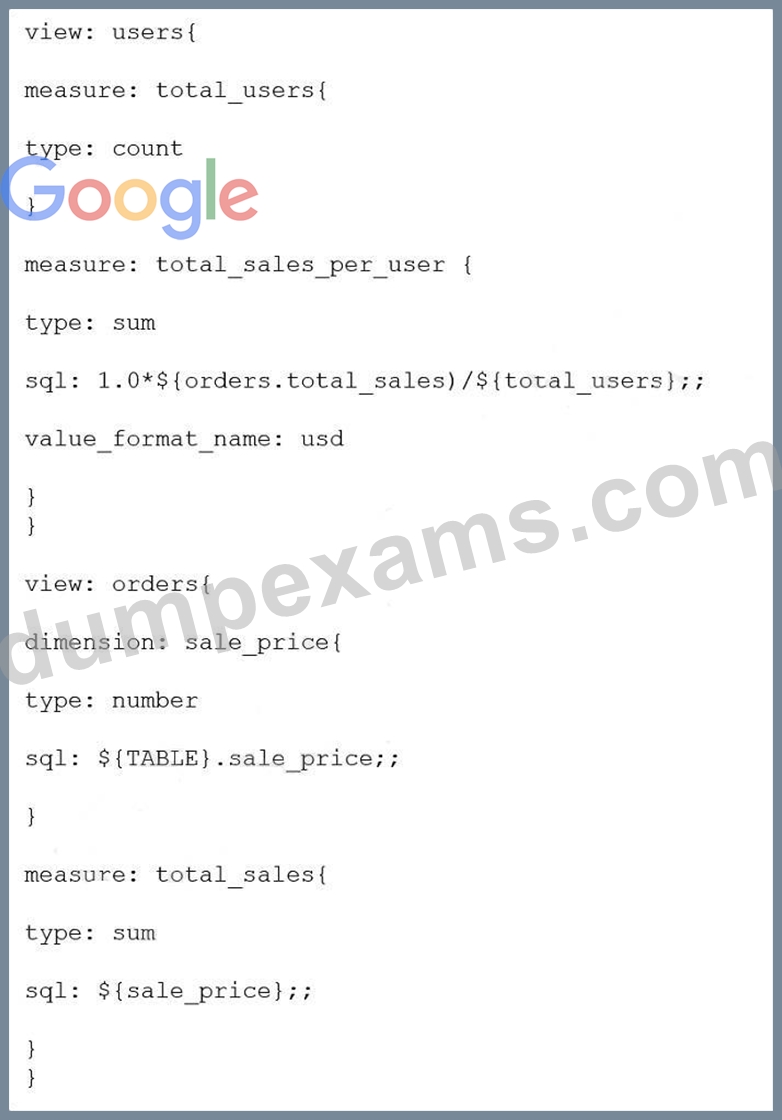
B)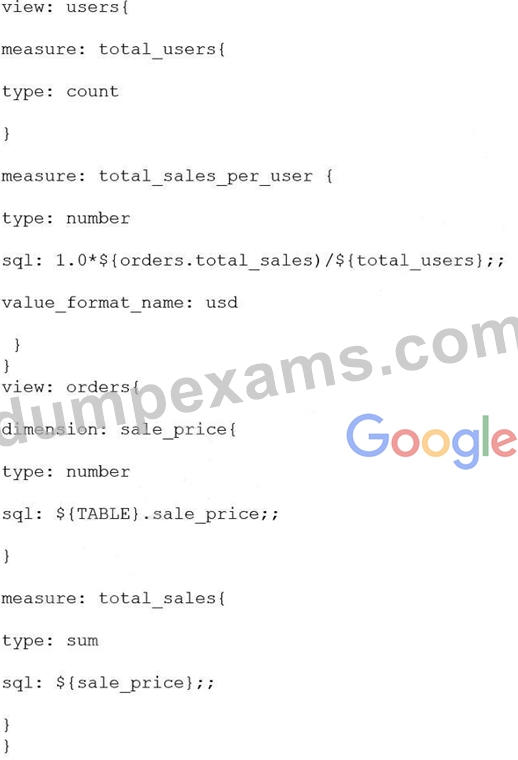
C)
D)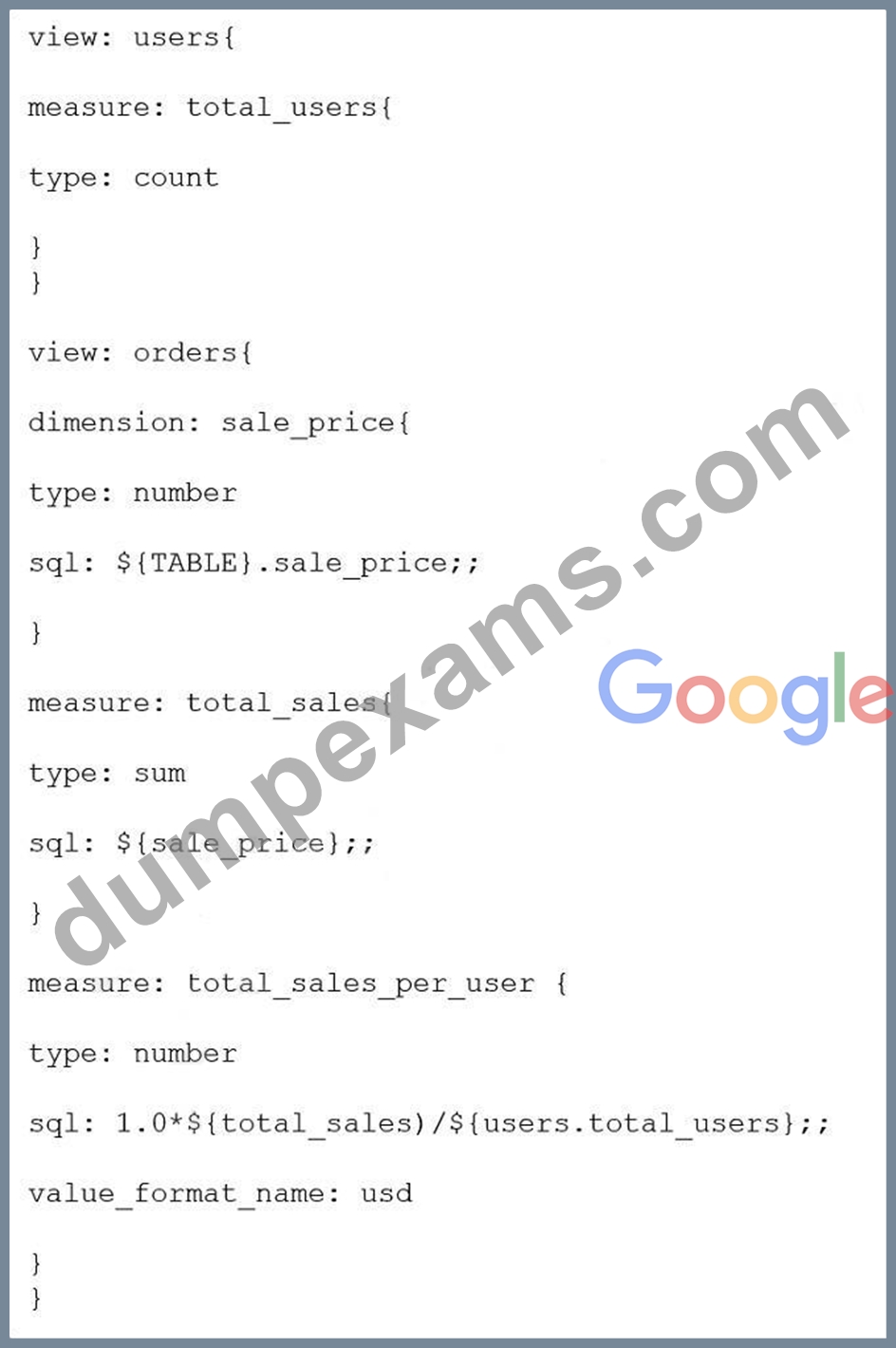
E)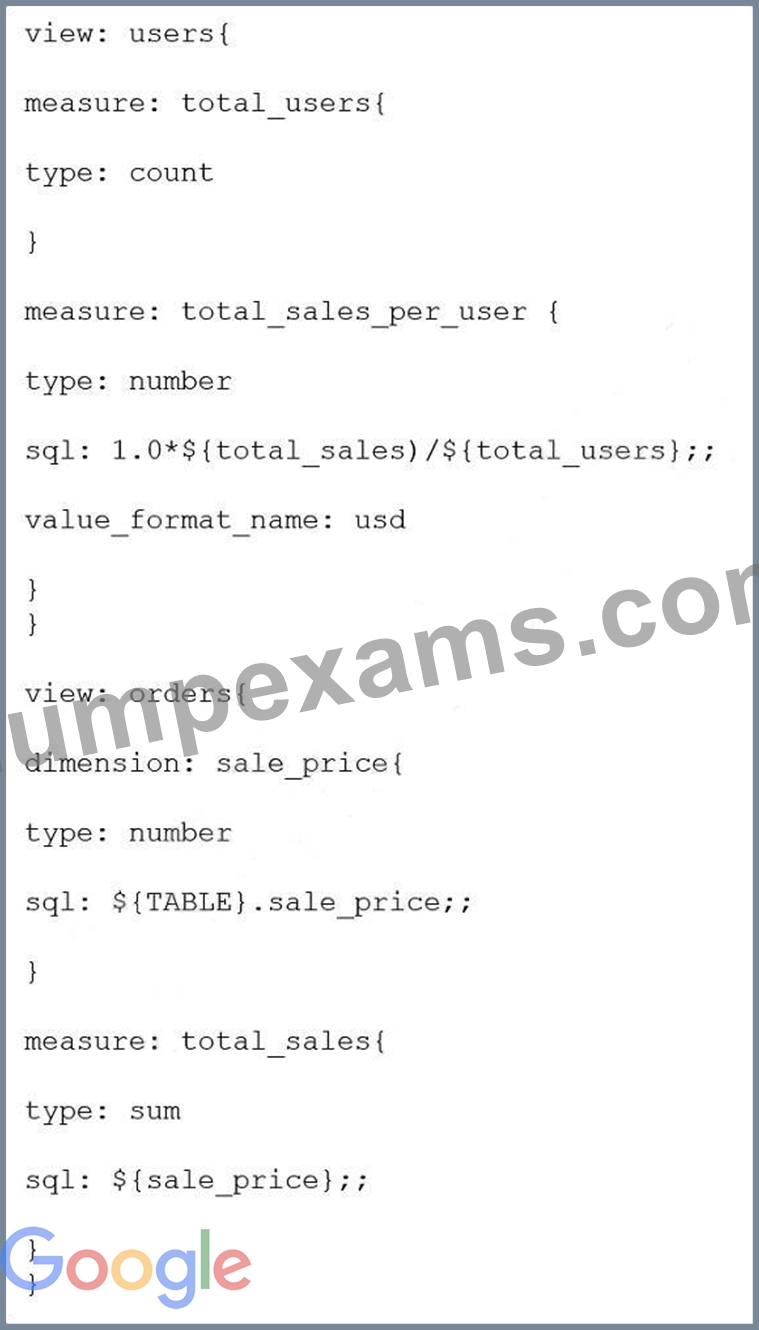
- A. Option E
- B. Option C
- C. Option D
- D. Option B
- E. Option A
Answer: B,E
NEW QUESTION 39
A developer needs to add an Explore built off of the orders view, which surfaces only completed orders. An orders Explore exists that contains all order information. Fields from the orders view are also referenced in other existing views such as ${orders.fieldname}.
How should developer define a new Explore for completed orders and keep all field references working correctly?
A)
B)
C)
D)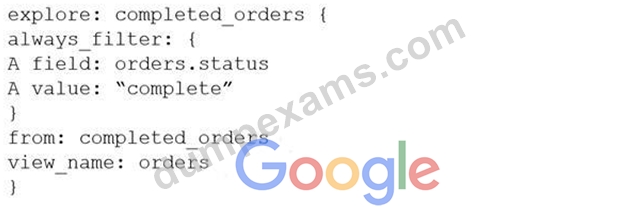
- A. Option C
- B. Option D
- C. Option B
- D. Option A
Answer: A
NEW QUESTION 40
A user reports that, when a date dimension is filtered to "before now" results are returned that consistently include tomorrow. Dimension fill has been ruled out as a cause of the issue.
Which LookML parameter should be used to resolve this issue?
- A. Week_start_day
- B. Convert_tz
- C. Fiscal_month_offset
- D. Datatype
Answer: C
NEW QUESTION 41
A user reports that a query run against the orders Explore takes a long time to run. The query includes only fields from the users view. Data for both views is updated in real time. The developer runs the following query in SQL Runner and quickly receives results:
SELECT * FROM users.
What should the developer do to improve the performance of the query in the Explore?
- A. Add persist_for: "24 hours" to the orders Explore.
- B. Create a persistent derived table from the user's query.
- C. Create an ephemeral derived table from the user's query.
- D. Create an Explore with users as the base table.
Answer: D
NEW QUESTION 42
A LookML developer has a transactions view with several measures that each perform complex calculations involving multiple fields. The LookML developer creates an Explore based on the transactions view. The product team wants to perform further functions on these measures, such as SUM, AVG, MIN, MAX, and RANK. The team wants these further functions to be performed at different levels of detail: weekly, monthly, and yearly.
How can the LookML developer model these requirements and minimize the amount of code rewriting?
- A. Add measures to the transactions view of type: number to apply the required functions.
- B. Change the existing measures in the transactions view to dimensions, and add measures of the different required types.
- C. Create native derived tables using transactions as the explore_source.
- D. Create a constant for each measure so it can be reused across other areas of the LookML project.
Answer: C
NEW QUESTION 43
A developer wants to create a new Explore based on the order_items view. The developer creates an Explore in the ecommerce model file with the following definition:
explore: order_items {}
After saving and validations, the developer receives this LookML validator error:
Inaccessible view "inventory_items", "inventory_items" is not accessible in explore" "order_items". Check for typos and missing joins in explore "order_items".
What caused this error to appear?
- A. A field in the order_items view references a field in the inventory_items view.
- B. There is another Explore named order_items which references the inventory_items view.
- C. A field in the inventory_items view references a field in the order_items view.
- D. There is an Explore named inventory_items which references the order_items view.
Answer: A
NEW QUESTION 44
A user reports an error message on an Explore: "Non-unique value/primary key (or sql_distinct_key), value overflow or collision when computing sum".
What should the LookML developer check for in the joined views of the Explore?
- A. No concatenated primary keys are used.
- B. Symmetric_aggregates: no is not present in the Explore definition.
- C. The sum measure used is defined correctly.
- D. A unique primary key is defined in each view.
Answer: B
NEW QUESTION 45
......
LookML-Developer Sample with Accurate & Updated Questions: https://pdftorrent.dumpexams.com/LookML-Developer-vce-torrent.html